A brief history of photography
I am writing this from memory, without checking the facts. But not hallucinating.
. Around 1800, scientists studying salts of silver noticed that their samples would change colour when exposed to sunlight.
. So they tried depositing various silver compounds on glass plates (in complete darkness) then exposing parts of the plates to light.
. They then treating the plates chemically to develop and to fix the image so that it could be viewed in the light. It worked.
. The next step was to put the glass plate as one side of a light proof box, with a lens at the other end, forming an image on the glass plate.
. The photographic camera had been invented. But hardly with the convenience of the modern digital camera.
. The early photographers had to carry around a light-proof laboratory (a black tent) in which to prepare, then develop and fix their photographs.
. Because the plates were so big (8 or 10 inches square), the resolution on these early black and white photographs was excellent.
. Around 1850, photographers began to set themselves up in studios on the High Street to take family portraits.
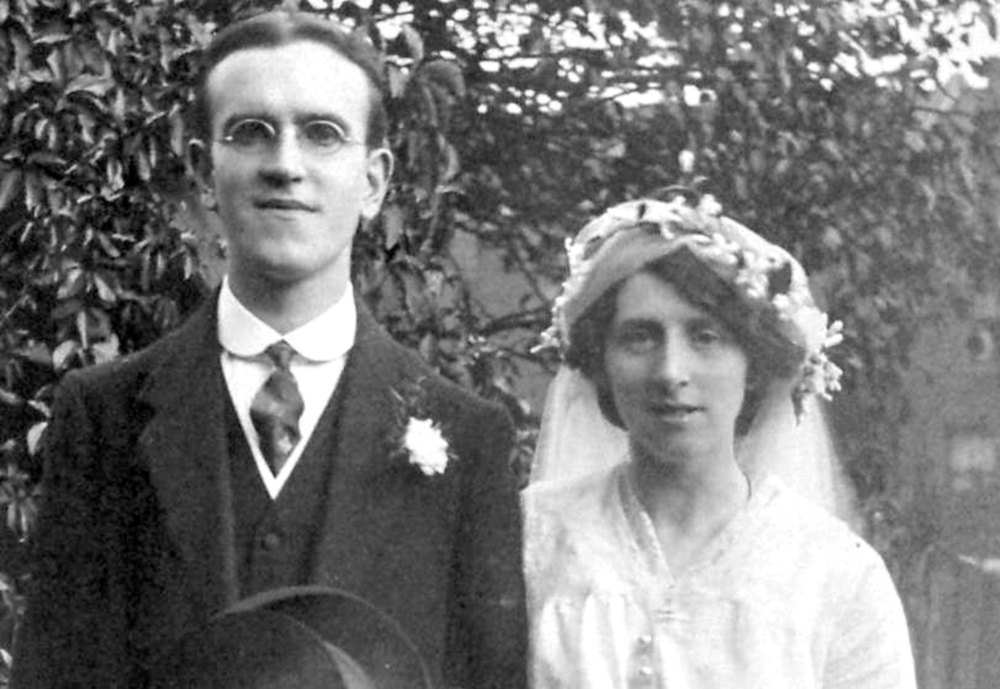
. There are numerous examples of this era in the photo album. A special occasion, best clothes, long exposure times and very formal poses.
. Like my grandparent's wedding here, in September 5, 1914.
. And then, in 1900, Eastman Kodak released the Box Brownie camera producing 12 photos approximately 2 inch square on a roll of film.
. The Box Brownie introduced the snapshot to the masses.
. By 1920, moving pictures had been perfected, later with sound added.
. In the 1930s, colour photography was in use, though very expensive.
. In the late 1940s, moving picture cameras for home movies on film (ciné cameras) became affordable. As did colour film.
. My Uncle Arthur Janering had a Pathé 9.5mm ciné camera - his films are in this album.
. My father-in-law, Ferrer Bassett, had a Leicina standard 8mm ciné camera, which I inherited. Again, many of his and my films are in this album.
. As television developed, electronic cameras, enormous and heavy at first, kept improving.
. In the 1970s, I was using an analogue video camera. Came with a heavy backpack.
. By the 1990s, the analogue electronic camera was small and cheap enough to become a consumer product.
. And then came the digital revolution. Tiny cameras, virtually no limit on the number of photos and videos you could take in one session, super cheap.